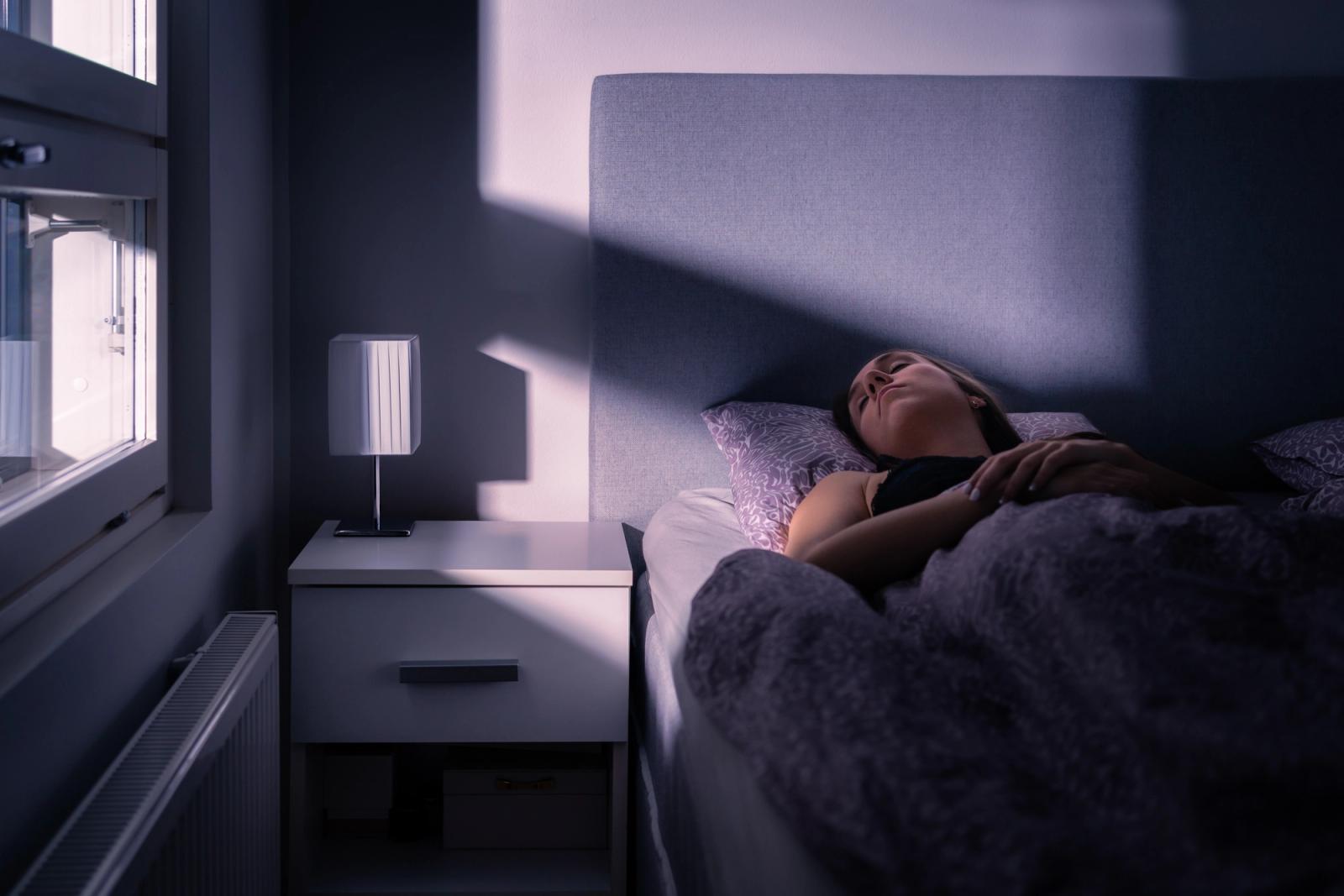
A wrist sensor measured light after bedtime for seven days rather than asking anyone to remember it. In the 11,071 UK Biobank adults whose hearts were later scanned, the most exposed group, an average of 33.9 minutes above 3 lux a night, carried 2.4 percent more left ventricular mass and 1.5 percent greater wall thickness than the group that logged none. Across the wider 73,286, heart failure ran at 361 cases per 100,000 person-years against 218. The study is observational and cannot show the light did it.
Lux is the unit for how much light falls on a surface, and the threshold in this study was three of them, a level NBC News described as that of a very dim room. The paper's reason for choosing it is that light as low as about 3 lux still suppresses nocturnal melatonin, the hormone the body releases in darkness that helps set when sleep comes. Among 11,071 British adults who wore a light sensor on the wrist for seven days and had their hearts imaged a median of 3.1 years later, the 2,416 in the most exposed group spent an average of 33.9 minutes a night above that line. The 3,438 who logged none spent no time above it at all.
Their scans differed by small and consistent margins. The most exposed group carried 2.4 percent more left ventricular mass, which is the weight of muscle in the heart's main pumping chamber, with a 95 percent confidence interval, the range the data leave plausible, of 1.6 to 3.1 percent. Average wall thickness ran 1.5 percent greater, interval 1.0 to 2.0. Myocardial contraction fraction, a measure of how much blood the chamber moves for the amount of muscle doing the moving, ran 1.9 percent lower, interval 1.1 to 2.7.
The same sensor week ran ahead of a longer count. Across 73,286 participants followed for a median of 7.9 to 9.5 years, heart failure appeared at 361 cases per 100,000 person-years in the most exposed group against 218 in the unexposed one. Heart attack ran 302 against 208, stroke 213 against 152, atrial fibrillation, an irregular and often rapid heart rhythm, 661 against 520, and death from cardiovascular causes 169 against 104. As hazard ratios, the model's estimate of how much higher one group's rate ran than the other's once the factors listed below had been adjusted for, that is 1.29 for heart failure, 1.24 for heart attack, 1.33 for stroke, 1.15 for atrial fibrillation and 1.26 for cardiovascular death, each with a confidence interval sitting entirely above 1: 1.12 to 1.49, 1.07 to 1.44, 1.11 to 1.59, 1.04 to 1.27 and 1.05 to 1.52 in the same order.
Sleep carried a large share of it. In the mediation analysis, a statistical method that asks how much of an association between two things runs through a third, shorter sleep accounted for 24 to 49 percent of the link between light and the cardiac measures, reaching 49 percent for relative wall mass. Sleep averaged 7.7 hours in the unexposed group and 6.9 hours in the most exposed. None of this was assigned. Nobody was given a dark bedroom or a lit one, so what the study shows is that these things travel together in this cohort, not that one produced the other.
How we know
UK Biobank is a prospective cohort, a large group recruited before anyone knows what will happen to them and then followed for years. Between 2013 and 2015, 103,615 of its participants wore an Axivity AX3 accelerometer with a built-in light sensor on the dominant wrist for seven days. The researchers took each person's least active five hours as their night, and counted the time spent above 3 lux inside that window. More than a quarter recorded none at all, so those people became the reference group and the rest were split into thirds, labelled low, intermediate and high.
The numbers above are analytic samples rather than the whole cohort, and the paper says how it got to them. From those 103,615 it set aside 27,557 whose accelerometer data was unreliable, 2,770 night-shift workers and 4,588 who already had cardiovascular disease. The incident-outcome analyses then ran on between 71,077 participants for atrial fibrillation and 73,286 for cardiovascular death, the count varying by outcome because each one also excluded people who already had that condition. The imaging analysis is smaller again: a further 57,629 had no cardiac MRI, or had been scanned before the sensor week, which is how 11,071 becomes the number behind every figure on the scans.
The participants were 61.1 years old on average, 56.6 percent of them women and 97.6 percent White, and 66.3 percent had high blood pressure. The models adjusted for sociodemographic and lifestyle factors, existing health conditions, air pollution measured as PM10, nitrogen dioxide and nitrogen oxides, the length of daylight around the sensor week, the season, and daytime light exposure, so the comparison is not simply between people who live in bright places and people who do not. The relationship held in a straight line across the range of exposure rather than switching on at some point: the test for non-linearity returned P values of at least 0.17 for the incident outcomes and at least 0.11 for the scans.
The paper is Nighttime light exposure and cardiac structure and function, published online in the European Heart Journal on 9 September 2026 by Jin Dai, Wen Dai and colleagues at Tulane University and the Harvard T.H. Chan School of Public Health, with Lu Qi as corresponding author. It was read here as the journal's advance article, tables included, and every figure above comes from it. NBC News's report of the study was read as the corroborating source and is where the quotations below come from.
What a 29 percent higher rate is 29 percent of
A hazard ratio of 1.29 for heart failure is the figure a headline reaches for, and on its own it says nothing about how likely heart failure is. The absolute numbers underneath it are 361 cases per 100,000 person-years against 218. A person-year is one person followed for one year, so 100,000 person-years is a hundred thousand people followed for a year, or fifty thousand followed for two. At 361 per 100,000 person-years, about 36 people in every ten thousand develop heart failure each year. At 218, about 22 do.
The gap is 143 cases per 100,000 person-years, roughly 14 people in every ten thousand each year. Across the whole follow-up the study counted 1,570 heart failures, 1,391 heart attacks, 996 strokes, 3,195 cases of atrial fibrillation and 884 cardiovascular deaths. Both ways of stating it are true at once, and the distance between them is the point: a 29 percent higher rate of something uncommon is still something uncommon.
Why it matters
What the sensor changes is the quality of the measurement. Light after bedtime is a thing almost nobody attends to, and asking people to recall it puts the weakest instrument available at the centre of the study. A wrist device worn for one week is not a perfect instrument either, and the paper says so, but it does not depend on anyone having noticed.
Lu Qi, who led the work, told NBC News that looked at together, the various structural and functional changes are pretty considerable; the report itself notes that each looks small on its own. Kristen Knutson of Northwestern University's Feinberg School of Medicine told the same report that closed eyelids do not shut light out at the levels the study measured. Thomas Münzel of Johannes Gutenberg University, writing an editorial alongside the paper, argued that darkness deserves recognition as a vital sign, as much a part of cardiovascular health as controlling blood pressure or breathing clean air.
Nobody has darkened a bedroom in a trial and watched what a heart does. This cohort cannot do it either: the people in it chose their own nights, and whatever else those choices carried came with them. What it does is put measured numbers on a question that had mostly rested on what people remembered, and the numbers are small enough that stating them plainly is the whole job. Whether a dark room changes a heart is a question a trial would have to answer, and that trial has not been run.
This is an observational cohort, so it cannot show that light at night damages hearts. Light was captured for one week, as illuminance only, with no record of its colour. Night-shift workers were excluded and the cohort was 97.6 percent White and healthier than the general population. The differences on the scans are small, a few percent at most, and the paper cannot say what any of them mean for one person.
Whether turning a light off changes a heart. Nobody in this study was assigned to a dark bedroom or a lit one; the researchers recorded what people were already exposed to and followed what happened, so the design cannot separate light at night from whatever else travels with it. It does not establish a threshold, because 3 lux was chosen to mark exposure and not to mark harm. It does not identify which wavelengths matter, the sensor having recorded only how much light there was and not its colour. It does not say whether the differences seen on the scans progress, reverse or stay put, since each heart was imaged once. And it does not report what happens in night-shift workers, who were excluded by design.
How much light is 3 lux?
The paper does not translate it into household objects; it chose the threshold because light as low as about 3 lux still suppresses nocturnal melatonin. NBC News described that level as a very dim room. Kristen Knutson of Northwestern University told the same report that closed eyelids do not shut out light at these levels.
Does this show that light at night causes heart disease?
No, and the authors say so. This is an observational cohort: nobody was assigned to a dark or a lit bedroom, so the study records that light and heart differences travelled together rather than that one produced the other. The models adjusted for lifestyle, existing conditions, air pollution, season, daylight length and daytime light, but adjustment cannot remove a factor nobody measured.
How big are these differences in plain numbers?
Heart failure appeared at 361 cases per 100,000 person-years in the most exposed group and 218 in the unexposed one, a gap of 143, which is about 14 people in every ten thousand each year. The differences on the scans were 2.4 percent more left ventricular mass, 1.5 percent greater wall thickness and 1.9 percent lower myocardial contraction fraction. The relative figures are larger-sounding than the absolute ones, and both describe the same result.
Who was not in this study?
Night-shift workers were excluded, 2,770 of them, along with 4,588 people who already had cardiovascular disease and 27,557 whose accelerometer data was unreliable. The remaining participants were 61.1 years old on average and 97.6 percent White, which is a narrower group than the population the findings might be applied to. Anyone whose heart was not imaged, or was imaged before the sensor week, is absent from the scan figures.
This is research reporting, not medical advice. We describe what studies found. We never tell you what to do. Talk to a doctor before changing anything about your health. Read our full position.
The evidence, read properly, every three days.
We read the paper so you do not have to. Free, and no supplement ads, ever.
Powered by Buttondown